
If you've been researching shelter protection or air safety systems, you've probably come across all three of these terms — CBRN, NBC, CBR — and wondered whether they actually mean the same thing or whether there's a real difference. You're not alone. Even people buying an NBC filtration system for their facility sometimes aren't sure which term applies to them. The honest answer is: they're closely related, but not identical. And understanding the difference helps you make smarter decisions about your protection setup. Let's break it down simply.
Where Did These Terms Come From — and Why Do They Keep Changing?
These acronyms didn't appear out of nowhere. They each came from a specific era of threat awareness — and each update reflects how the world's understanding of danger has evolved over time.
The oldest version was ABC — Atomic, Biological, and Chemical — which was widely used during the Cold War era but is now considered outdated because it lacks the specificity and modern threat awareness found in NBC and CBRN frameworks.
NBC — Nuclear, Biological, and Chemical — came next, used widely from the 1960s through the 1980s as the standard term for defense and protection systems against weapons of mass destruction.
Then came CBRN. The term CBRN — Chemical, Biological, Radiological, and Nuclear — was created in the 1990s as a direct replacement for NBC, with the addition of a separate "R" for Radiological specifically because of the growing threat of dirty bombs and radiological weapons that sit outside the traditional nuclear category.
So in plain terms: NBC came first, CBRN came later and is slightly more specific. Both are still used today depending on the country, the organisation, and the context.
What is the actual Difference Between NBC and CBRN?
This is the part most people get confused about — and it's actually simpler than it sounds.
NBC includes the same threats as CBRN but treats radiological hazards as a subset of the nuclear category, rather than giving them their own separate classification.
In practical terms, the two terms are virtually interchangeable — since radiological threats are relatively infrequent compared to chemical or biological risks, and both NBC and CBRN systems are built to handle the same range of real-world threats.
This is exactly why you'll often see the term NBC/CBRN filtration systems used together — because manufacturers and suppliers want to make clear that their system covers the full range, regardless of which label a buyer is familiar with.
In the filtration industry specifically, NBC, CBRN, CBR, and ABC are all treated as common abbreviations of similar meaning — covering nuclear or radiological, chemical warfare, and biological threats — and most technical professionals simply use NBC as a catch-all term for all of the above.
What about CBR — Is That Different Too?
CBR stands for Chemical, Biological, and Radiological — dropping the nuclear component entirely. It is used in specific contexts where nuclear blast protection is not part of the threat profile being addressed, but air contamination from chemical, biological, or radiological sources still is.
CBRN is the most general and versatile term, covering the broadest range of hazards — while NBC and CBR are each designed to protect against a specific subset of those same CBRN threats.
In practice, when someone is specifying or purchasing a CBRN filtration system for a shelter, hospital, or government building — the system they receive is almost always built to handle the full spectrum anyway. The label on the paperwork may say NBC or CBRN, but the actual protection delivered is the same.
Does the Label on an NBC Filtration System Actually Matter for What It Protects Against?
Yes and no — and this is an important practical point.
The label matters for certification purposes. Different countries and defence organisations use different terminology in their official standards documents. CBRN terminology is used in modern international safety protocols, military doctrines, and civil defence strategies — including those defined by NATO and the United Nations Office for Disarmament Affairs.
So if a procurement document says you need a "CBRN-rated system," you need one that meets CBRN certification standards — not just any air purifier labelled as NBC. The NBC filtration system you install must carry the right certifications for the country and application it is being used in.
What the label does NOT change is the fundamental way the system works. Whether it says NBC or CBRN on the box, a proper NBC/CBRN filtration system operates on the same principle: pull contaminated outside air in, strip it through multiple filter layers, and deliver only clean safe air into the protected space — while maintaining overpressure inside to stop contaminated air from sneaking back in through gaps.
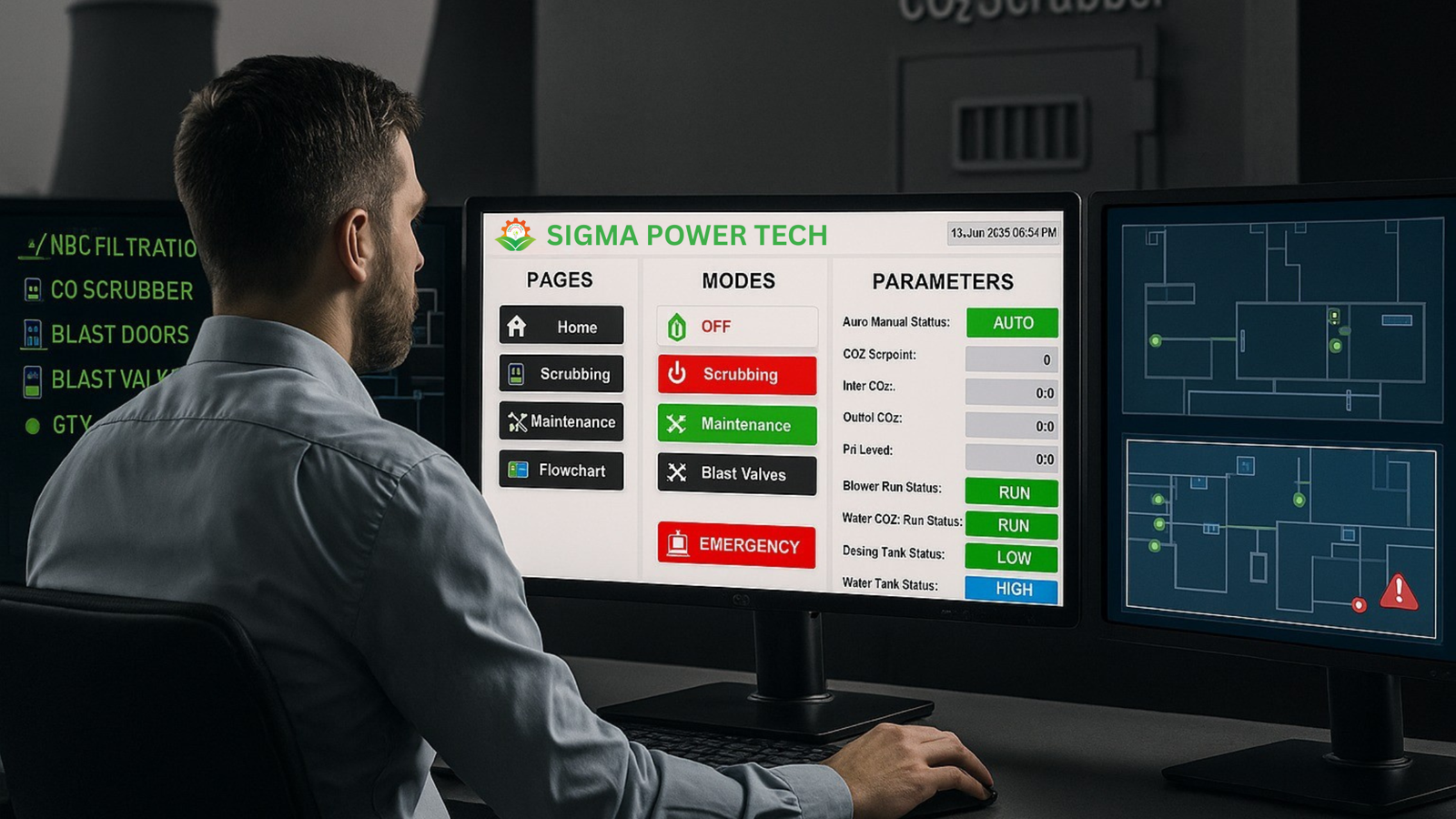
The NBC detector monitors outside air for any sign of threat. The NBC control panel manages the entire system response automatically. And the CBRN filtration system runs continuously to keep everyone inside safe — regardless of what three-letter acronym appears on the label.
Which term should You Use When Specifying a System?
Since July 2005, organisations like the Canadian Armed Forces officially switched from "NBC Defence" to "CBRN Defence" — and NATO, national defence agencies, and international disaster response organisations now predominantly use the term CBRN defence.
For most buyers in India and internationally, using either NBC or CBRN is perfectly understood. When in doubt, use NBC/CBRN filtration systems together — which is exactly how Sigma Power Tech describes our systems, because we want every buyer to know the full protection scope of what they are getting.
The key questions when selecting any NBC or CBRN filtration system remain the same regardless of the label: how many people need protection, how long they may need to stay inside, what specific threats are most likely in your region, what airflow is required, and what power and backup systems are in place.
Conclusion
CBRN, NBC, and CBR are not the same thing — but they are very closely related, and in the world of air filtration and shelter protection, they often point to the same equipment and the same level of protection.
What matters far more than the label is whether your NBC filtration system is properly certified, correctly sized for your space, professionally installed, and regularly maintained. A well-designed CBRN filtration system — complete with an NBC detector, NBC control panel, and multi-layer filtration — keeps people safe regardless of whether the threat outside is chemical, biological, radiological, or nuclear.





Write a comment ...